
Restorative Dentistry · Sunridge, Calgary
A missing tooth can affect more than your smile. It may change how you chew, speak or feel in photos. Several tooth replacement options can help restore function and confidence. The best choice depends on your oral health, how many teeth are missing, your preferences and your budget.
Discuss Your OptionsWhat are the options for replacing a missing tooth?
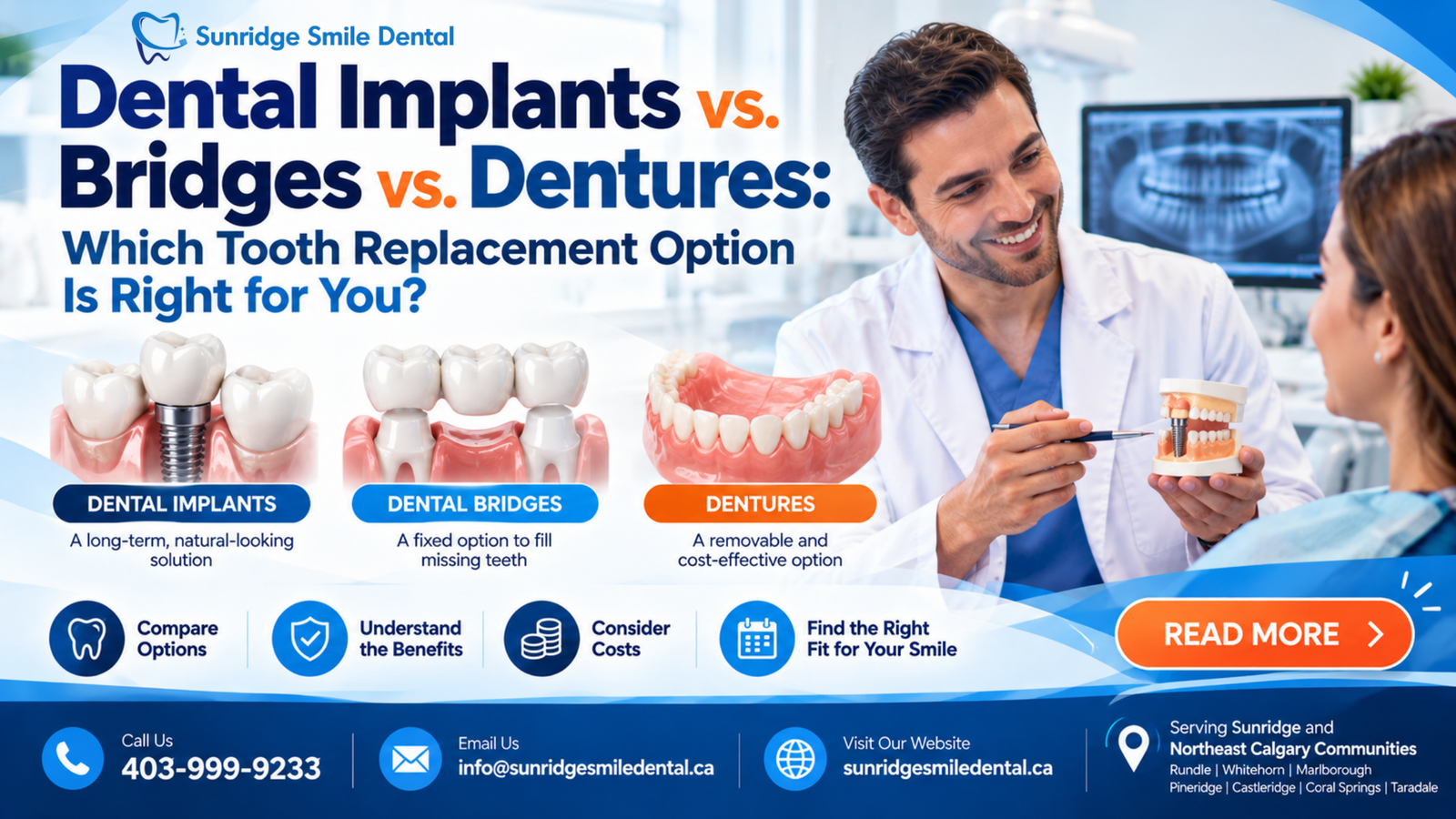
The main options for replacing missing teeth are dental implants, dental bridges and removable dentures. An implant uses a post placed in the jawbone to support a replacement tooth; a bridge fills the gap by attaching an artificial tooth to neighbouring teeth or implants; and a partial or complete denture replaces several or all teeth and can be removed for cleaning. Suitability depends on gum health, available bone, the number and position of missing teeth, treatment time, maintenance needs and cost.
There is no single option that is right for everyone. A dental examination helps your dentist assess the gap, surrounding teeth and gums, your bite and any medical factors that could affect treatment.
Dental implants vs. bridges vs. dentures: a quick comparison
| Feature | Dental implant | Dental bridge | Denture |
|---|---|---|---|
| How it works | A post in the jaw supports a crown or other restoration. | An artificial tooth is supported by nearby natural teeth or implants. | A removable appliance replaces one or more teeth, or a full arch. |
| Fixed or removable? | Usually fixed once restored. | Fixed; patients do not remove it themselves. | Usually removable; some attach to implants for added retention. |
| Nearby teeth | May avoid preparing healthy neighbouring teeth. | A traditional bridge usually requires preparing supporting teeth. | May use clasps or rest on the gums; design depends on the case. |
| Treatment timing | Often takes months because healing may be needed. | Often completed over several visits; timing varies. | Timing varies; healing or adjustments may be needed. |
| Daily care | Brush and clean around the restoration; attend checkups. | Brush and clean underneath with a floss threader or suitable tool. | Remove and clean as instructed; care for gums and remaining teeth. |
| Often considered for | One or more missing teeth when health and bone allow. | One or a few missing teeth with suitable support. | Several or all missing teeth, or when a removable option is preferred. |
This is a starting point, not a diagnosis. Implant-supported bridges and dentures are also possible. Your dentist may recommend other approaches depending on your needs.
1. Dental implants: a replacement tooth anchored in the jaw
A dental implant is a small post, commonly made from titanium, placed in the jawbone to act like a replacement tooth root. After healing and integration with the bone, a connector and custom-made crown can be attached. Implants can also support bridges or dentures when several teeth are missing.
Potential benefits
- Stable function: a completed implant restoration is fixed in place and is not removed for routine cleaning.
- May preserve nearby teeth: a single implant can often replace a tooth without reshaping neighbouring teeth for bridge crowns.
- Supports the jawbone locally: an implant transfers chewing forces to the bone around it, although it cannot guarantee that bone changes will never occur.
- Natural-looking results: the crown is designed to fit the space and blend with surrounding teeth.
What should you consider?
Implant treatment involves surgery and healing. The overall timeline can extend over several months, and bone grafting or other procedures may be needed if there is not enough suitable bone. Healthy gums, good oral hygiene and control of conditions that affect healing are important. Smoking can increase complications, so discuss tobacco use and your medical history honestly with your dentist.
Implants may have a higher initial cost than other options. They need ongoing home care and professional monitoring; the crown, screws or surrounding tissues can develop problems and may need maintenance. An implant is not automatically the best option just because it is fixed.
Learn more about dental implants at Sunridge Smile Dental.
2. Dental bridges: a fixed way to fill a gap
A dental bridge replaces one or more missing teeth by spanning the gap. In a traditional bridge, the replacement tooth is connected to crowns placed on supporting teeth on either side. Some bridges attach to dental implants instead, and other designs may suit selected cases.
Potential benefits
- Fixed in place: a conventional bridge is not removed by the patient for daily cleaning.
- May take less time than implant treatment: many tooth-supported bridges can be completed over a few visits, although complexity affects timing.
- Restores chewing and appearance: it fills the space and can help prevent nearby teeth from drifting into it.
- Alternative to implant surgery: a bridge does not require placing an implant into the jawbone.
What should you consider?
A traditional bridge usually requires reshaping the supporting teeth. That is an important consideration if those teeth are healthy. Plaque can collect around the bridge, and cleaning underneath the replacement tooth takes extra care. The supporting teeth and gums must remain healthy, and the bridge may eventually need repair or replacement.
A bridge can be practical when teeth beside the gap already need crowns, when an implant is unsuitable, or when a patient prefers a fixed restoration without implant surgery. Your dentist can explain which design, if any, fits your situation.
Explore the clinic’s crowns and bridges service.
3. Dentures: removable replacement teeth
Dentures are custom-made appliances that replace missing teeth and some of the surrounding gum appearance. A partial denture replaces several teeth when some natural teeth remain. A complete denture replaces all teeth in an upper or lower arch. Some dentures attach to implants for improved retention, while still being removable by the patient.
Potential benefits
- Can replace multiple teeth: one appliance may restore several gaps or a full arch.
- Usually avoids implant surgery: conventional dentures do not require an implant placed in the jawbone.
- Can be adjusted: relining, adjustments or replacement may help maintain fit as the mouth changes.
- Offers flexibility: dentures may suit patients who prefer a removable solution or have health, bone or financial factors that make other options less suitable.
What should you consider?
New dentures can feel unfamiliar, and it may take time to adjust to speaking and chewing. They can rub or become loose, particularly as the gums and jaw change. Follow-up visits may be needed for adjustments. Dentures should be removed and cleaned according to your dentist’s instructions, and remaining natural teeth and gums still need daily care.
Do not try to repair or reshape a denture yourself. If it becomes painful, cracked or loose, arrange a dental appointment. An ill-fitting appliance can cause sore spots and make eating difficult.
Read more about denture services at Sunridge Smile Dental.
How do you choose the right tooth replacement option?
The right choice depends on the condition of your mouth and what matters most to you. During a consultation, your dentist can examine the area, assess your bite and gums, and recommend imaging if clinically appropriate. Consider these factors together rather than choosing on price or appearance alone.
How many teeth are missing?
For one missing tooth, an implant crown or bridge may be considered. For several missing teeth, options may include multiple implants, an implant-supported bridge, a tooth-supported bridge or a partial denture. When all teeth in an arch are missing, complete dentures or implant-supported options may be discussed.
What is the condition of the surrounding teeth and gums?
Healthy supporting teeth can be important for a traditional bridge. Gum disease should be assessed and managed before many restorative treatments. Implants also require healthy tissues and sufficient suitable bone. If bone volume is limited, additional treatment may or may not be possible. Your dentist will explain the findings and alternatives.
What treatment timeline works for you?
If you need a solution within a short timeframe, ask about realistic timelines and whether a temporary replacement is appropriate. Implant treatment commonly requires healing. Bridges and dentures can sometimes be completed sooner, but preparation, extractions, healing and laboratory work can affect any option’s schedule.
What is your budget and coverage?
Ask for a written treatment plan that separates the initial procedure, laboratory fees, temporary appliances, follow-up care and possible future maintenance. Compare long-term upkeep as well as the initial estimate. If you have dental benefits or CDCP coverage, ask the clinic to confirm whether the specific service is eligible and what costs you may be responsible for before treatment. Coverage is subject to plan rules and is not guaranteed for every procedure.
How much daily maintenance are you comfortable with?
Every option requires care. Implants and bridges need careful brushing and cleaning around or underneath the restoration. Dentures need removal and cleaning, as well as care for remaining natural teeth and gums. Choose an option you can maintain consistently.
Cost, lifespan and maintenance: what should you ask?
There is no single price that applies to every patient in Calgary. The cost of tooth replacement depends on how many teeth need replacing, the restoration design and materials, the condition of surrounding teeth and gums, imaging, extractions, bone grafting, laboratory work and follow-up care. A consultation is the best way to receive an estimate based on your needs.
When comparing estimates, ask your dental team:
- What exactly is included in the quoted fee?
- Will I need an extraction, graft, temporary tooth or additional treatment?
- How many appointments are expected, and what is the likely timeline?
- What cleaning tools and follow-up visits will I need?
- What repairs or replacement costs could arise later?
- Can the clinic check my dental plan or CDCP eligibility for the proposed treatment?
Longevity varies with oral hygiene, bite forces, health conditions, restoration design and regular professional care. No restoration lasts forever, and an implant post, crown, bridge or denture can each require maintenance at different times. Be cautious of any promise that a treatment will last a guaranteed number of years.
Why replacing a missing tooth may matter
A missing tooth does not always cause an immediate problem, but the gap can affect chewing and allow neighbouring teeth to drift in some cases. Tooth loss may also be associated with changes in the jawbone in the area. The impact depends on which tooth is missing, your bite and your overall oral health.
That does not mean every gap requires the same treatment or that you must choose an implant. Some spaces may be managed differently depending on the circumstances. Ask your dentist about the likely effects of replacing—or not replacing—the tooth, the available alternatives and the risks of delaying treatment.
Considering tooth replacement in Sunridge or Northeast Calgary?
If you live in Sunridge, Rundle, Whitehorn, Marlborough, Pineridge, Castleridge, Coral Springs or Taradale, Sunridge Smile Dental can help you discuss restorative dentistry options. A dental assessment can clarify which treatments may be suitable, what each involves and what costs to plan for.
Visit the clinic at #102, 3393 26 Ave NE, Calgary, AB T1Y 6L4, or call 403-999-9233. You can also use the online contact form to request an appointment.
Explore your tooth replacement options
Get answers about implants, bridges and dentures based on your dental needs, preferences and budget.
Frequently asked questions
What is the best option for replacing a missing tooth?
There is no universally best option. Implants, bridges and dentures have different benefits and limitations. The most suitable choice depends on oral health, surrounding teeth, bone, treatment goals, timeline and budget.
Are dental implants better than bridges?
Not for every patient. An implant may replace a tooth without preparing adjacent teeth, but it involves surgery and healing. A bridge may be faster and avoids implant surgery, but a traditional bridge usually requires reshaping supporting teeth. Your dentist can compare the options for your case.
Are dentures a good option if I am missing several teeth?
Yes, partial dentures can replace several teeth, and complete dentures can replace all teeth in an arch. Fit, comfort, remaining teeth, bone and personal preferences help determine whether conventional or implant-supported dentures are appropriate.
How long does tooth replacement treatment take?
Timing varies. A bridge or denture may be completed over several appointments, while implant treatment often takes months because the implant may need time to integrate with the bone. Extractions, healing, grafting and laboratory work can change the schedule.
Do dental implants, bridges and dentures look natural?
All three can be designed to look natural. Appearance depends on materials, design, fit, gum condition and how well the restoration is matched to surrounding teeth.
How do I clean a dental bridge?
Brush twice daily and clean under the bridge with a floss threader or another tool recommended by your dental professional. Regular checkups and professional cleanings help monitor the bridge and supporting teeth.
Can I get dental implants if I have bone loss?
Possibly, but it depends on the amount and location of bone and other health factors. Some patients may be considered for bone grafting; others may be advised to choose a different option. An examination and appropriate imaging are needed to assess suitability.
Does dental insurance or the CDCP pay for tooth replacement?
Coverage depends on your plan, eligibility, the service, plan rules and any applicable limits or co-payments. Ask the clinic to verify the proposed treatment and explain estimated out-of-pocket costs before proceeding.
Where can I discuss tooth replacement options near Sunridge?
Sunridge Smile Dental is located at #102, 3393 26 Ave NE, Calgary. Call 403-999-9233 or use the clinic’s contact page to ask about an appointment.