
Patient Guide · Sunridge, Calgary
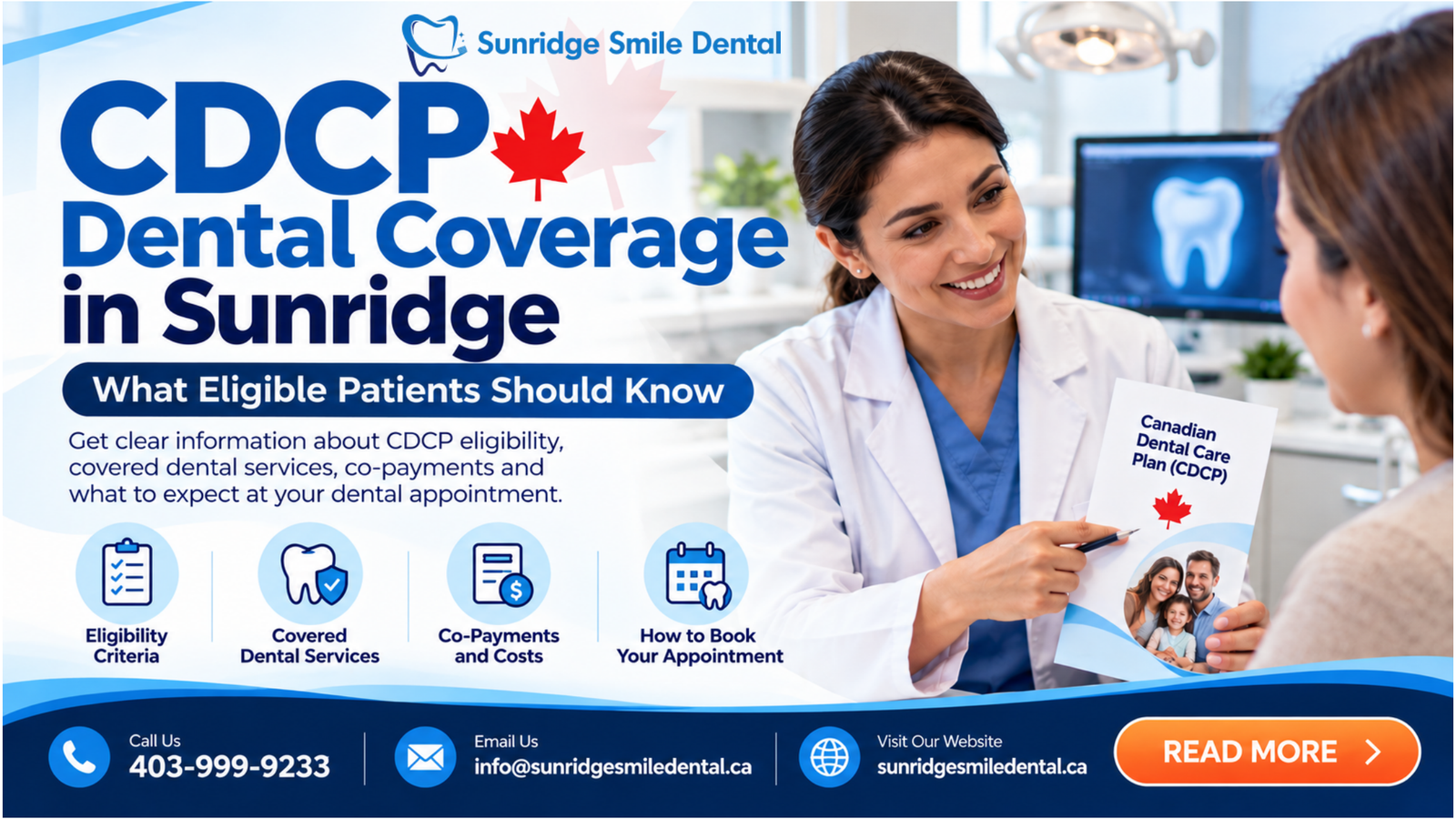
Dental care can be easier to plan when you understand what your benefits may cover before you sit in the dental chair. If you live in Sunridge or Northeast Calgary and have Canadian Dental Care Plan (CDCP) coverage, this guide explains the basics—from eligible services and co-payments to the questions worth asking before treatment.
Coverage can change and individual treatment decisions vary. Confirm your current benefits and estimated patient costs with your dental provider and the official CDCP resources before proceeding.
What dental services does the CDCP cover?
The Canadian Dental Care Plan may help pay for eligible exams, X-rays, cleanings, fluoride, fillings, root canal treatment, gum care, extractions, dentures and certain other services. Coverage depends on your eligibility, the CDCP fee schedule, service-specific rules and frequency limits, whether preauthorization is required, and any applicable co-payment or additional provider charges. Not every treatment is covered, and approval should be confirmed before proceeding when required.
What is the Canadian Dental Care Plan?
The Canadian Dental Care Plan is a federal program intended to make eligible oral health services more accessible for Canadian residents who do not have access to private dental insurance and meet the other program requirements. It can help with the cost of a range of dental services, but it is not an unlimited dental plan and does not automatically make every treatment free.
Your benefits depend on the current program rules, the type of service recommended, the CDCP-established fee for that service, your applicable co-payment level and any service-specific conditions. A treatment estimate is therefore more useful than assuming that a service is fully covered because it appears on a general list.
For the latest program details, consult the Government of Canada’s Canadian Dental Care Plan information and its coverage overview.
Who may qualify for CDCP in Alberta?
Eligibility is determined by the federal program—not by the dental clinic. As a general guide, applicants must meet all of the program’s current eligibility requirements, which include the following:
- No access to private dental insurance or coverage. This can include coverage through an employer, a spouse or partner, a pension, a student plan, an association or an individually purchased plan. Having access to a plan may matter even if you do not use it.
- Adjusted family net income below $90,000. Your adjusted family net income is calculated using tax-return information and applicable adjustments.
- Canadian resident for tax purposes. The same condition applies to a spouse or common-law partner, where applicable.
- Tax returns filed for the relevant year. Your spouse or common-law partner must also have filed if the rules require it.
People with dental benefits through certain government social programs may still qualify. The programs may coordinate benefits according to their rules. Do not cancel or decline existing coverage based on assumptions about CDCP eligibility; check the official requirements first.
Eligibility and coverage must be maintained and renewed according to the program’s current process. Review the official CDCP eligibility requirements before applying or renewing.
Which dental services may be covered by the CDCP?
The CDCP includes a range of service categories when the patient, treatment and circumstances meet its rules. Coverage is always subject to the applicable benefit grid, frequency limits and any preauthorization requirements.
1. Exams and diagnostic services
Depending on your benefit rules and clinical needs, eligible services may include dental examinations and X-rays. These help a dental professional assess teeth, gums and other oral structures, identify problems and plan appropriate care. The type and frequency of an exam or image may be subject to program limits.
2. Preventive care
Eligible preventive services may include professional scaling or cleaning, fluoride applications and sealants. Preventive visits can help identify concerns earlier, but the plan’s frequency rules still apply. Your dentist or hygienist can explain which preventive services are appropriate for you and whether they are eligible on the date of your visit.
3. Fillings and other restorative treatment
Eligible restorative services may include certain permanent or temporary fillings and other treatments for cavities or damaged teeth. Whether a particular procedure is covered depends on the clinical situation and the plan’s rules. Ask for an estimate that identifies the recommended procedure and any potential patient portion.
4. Root canal and pain-related treatment
Some endodontic services, including eligible root canal procedures, may be covered. Certain retreatments or circumstances may require preauthorization. If you have tooth pain, swelling or a suspected infection, contact a dental professional promptly rather than delaying care while trying to interpret benefit details on your own.
5. Gum and periodontal care
Eligible periodontal services may include certain types of cleaning below the gumline and treatment for gum disease. Coverage can depend on the service, clinical findings, frequency limits and approval requirements. A dental professional can explain the difference between routine cleaning and periodontal treatment when preparing your care plan.
6. Extractions and other oral surgery
Some tooth and root removals and other eligible oral surgery services may be covered. Coverage is not a blanket approval for every surgical procedure, so ask the clinic to verify the exact treatment code and any approval requirements before treatment.
7. Dentures and selected major services
Eligible denture services and certain repairs or adjustments may be covered. Some partial dentures, immediate dentures, crowns and related major services have specific eligibility criteria and may require preauthorization. A dentist may need to submit clinical information before the plan makes a coverage decision.
What about braces, Invisalign or teeth whitening?
Do not assume that orthodontic treatment or cosmetic services are covered. The official CDCP coverage page currently states that orthodontic services are not available under the plan. Whitening and other cosmetic treatments should not be presumed eligible. Confirm the current benefit rules for the exact service you are considering.
For the full and current service list, refer to the Government of Canada’s CDCP covered services page and Dental Benefits Guide.
Will the CDCP cover 100% of your dental costs?
Not necessarily. Your share can include a co-payment and additional charges that are not covered by the plan. These are two different things, and understanding the difference helps avoid surprises.
How co-payments work
Under the published general income-based structure, the CDCP pays a percentage of eligible services at CDCP-established fees. The patient’s co-payment is the remaining percentage of those established fees.
| Adjusted family net income | CDCP pays at established fees | Patient co-payment at established fees |
|---|---|---|
| Below $70,000 | 100% | 0% |
| $70,000–$79,999 | 60% | 40% |
| $80,000–$89,999 | 40% | 60% |
These percentages apply to eligible services at CDCP-established fees—not necessarily to the full fee a provider charges. Check the current official program guidance before relying on these figures, as program rules and fee schedules can change.
Why might you still have an out-of-pocket cost?
- The provider’s fee is higher than the CDCP-established fee. The plan’s fee schedule may differ from the clinic’s usual fee.
- A co-payment applies. Depending on your adjusted family net income, you may owe a portion of the eligible CDCP fee.
- The service is not covered. You are responsible for treatment you choose that is not eligible under the plan.
- A limit or approval rule applies. A service may be subject to frequency limits or preauthorization and may not be payable if the applicable requirements are not met.
Before agreeing to treatment, ask for a written estimate that explains the proposed service, the amount expected from the CDCP, any co-payment, and any other amount you may need to pay. A preliminary estimate or preauthorization decision is useful, but final payment can still depend on the rules in effect when care is provided.
How to prepare for a CDCP dental appointment
A few simple steps can make your visit smoother and help you understand the likely costs before treatment begins.
- Check that your coverage is active. Review your CDCP welcome or coverage information and benefit period.
- Bring your plan details. Have your CDCP member information and any requested identification available. Do not send sensitive details through an unsecured message.
- Explain your dental concern. Tell the clinic whether you need a checkup, cleaning, help with pain, a filling or another service.
- Ask the provider to verify the proposed services. Coverage depends on the exact procedure, your current benefits and the applicable rules.
- Discuss the estimated patient portion. Ask about co-payments, fee differences and any services that may not be covered.
- Confirm preauthorization when needed. If approval is required, find out whether it has been submitted and decided before proceeding with that service.
- Keep your records and renew on time. Save estimates and treatment information, and follow the official renewal process to help prevent a gap in coverage.
CDCP members generally should not pay the full cost upfront and then expect Sun Life to reimburse them personally. The provider submits eligible claims, and the patient pays any outstanding amount not covered by the plan. Confirm the payment arrangement with the clinic before treatment.
Finding a CDCP dentist in Sunridge, Calgary
If you’re searching for a CDCP dentist in Sunridge, look for a dental office that can explain the plan clearly, verify coverage for proposed services and discuss potential patient costs before treatment. These questions are useful whether you live in Sunridge, Rundle, Whitehorn, Marlborough, Falconridge, Castleridge or Abbeydale.
Sunridge Smile Dental welcomes patients with CDCP coverage. The team can discuss your dental needs and help you understand the next steps for an appointment. Your specific eligibility, service coverage and patient costs must still be confirmed under the program rules.
Sunridge Smile Dental
Have questions about your CDCP benefits?
#102, 3393 26 Ave NE, Calgary, AB T1Y 6L4
Call to ask about appointment availability and what information to bring.
Explore the clinic’s CDCP coverage information, or learn more about relevant care options such as dental cleaning, comprehensive exams and X-rays, dental fillings, and children’s dentistry.
Frequently asked questions about CDCP dental coverage
What dental services does the CDCP cover?
Eligible services may include exams, X-rays, cleaning, fluoride, sealants, fillings, some root canal and gum treatments, extractions, dentures and selected major services. Coverage depends on the CDCP fee schedule, eligibility, service rules, frequency limits, preauthorization and applicable co-payments.
Can I use the CDCP at a dentist in Sunridge?
Sunridge Smile Dental welcomes CDCP patients. Contact the clinic before your visit to discuss appointment availability, confirm the information you should bring and ask how your proposed treatment and estimated costs will be checked.
Does the CDCP cover dental cleaning?
Eligible scaling and other preventive services may be covered, subject to the plan’s frequency limits and service rules. Ask the dental office to confirm which preventive services are eligible for you and whether any patient costs may apply.
Does CDCP cover fillings and root canals?
Some fillings and root canal treatments may be eligible. Coverage depends on the exact procedure and applicable plan rules; some services or repeat treatments may require preauthorization.
Is CDCP dental care completely free?
No. Depending on your adjusted family net income, you may have a co-payment. Additional costs can also apply when a provider’s fee is higher than the CDCP-established fee or when a service is not covered. Ask for a cost estimate before treatment.
Who is eligible for the Canadian Dental Care Plan?
Applicants generally must have no access to private dental insurance, have adjusted family net income below $90,000, be Canadian residents for tax purposes and have filed the required tax return. Check the Government of Canada’s current eligibility rules for full details.
Does CDCP cover braces or Invisalign?
Orthodontic services are currently listed by the Government of Canada as unavailable under the CDCP. Do not assume braces or Invisalign are covered; check the official service list for current rules.
Do I need preauthorization before dental treatment?
Some services require preauthorization, including certain major procedures or services beyond frequency limits. Ask your dentist whether your proposed treatment needs approval and wait for the required decision before proceeding with that service.
Can I visit a CDCP dentist if I live in Rundle, Whitehorn or Marlborough?
Patients from Rundle, Whitehorn, Marlborough and other Northeast Calgary communities can contact Sunridge Smile Dental to ask about appointments. Coverage remains subject to your active CDCP benefits and the service-specific rules.
Where can I check the official CDCP coverage rules?
Use the Government of Canada’s official CDCP coverage page, eligibility page and Dental Benefits Guide.
Make your CDCP dental visit a more informed one
The Canadian Dental Care Plan can help eligible patients access a range of oral health services, but the details matter. Check your eligibility and active coverage, ask which services are eligible, confirm whether preauthorization is needed, and discuss any co-payment or extra charges before agreeing to treatment.
If you live in Sunridge or Northeast Calgary and have questions about arranging a visit, contact Sunridge Smile Dental to discuss your needs and next steps.